
Ancient Landmarks
Koukaki: Living Beneath the Acropolis
Stay in Koukaki and ancient Athens never feels far away. The neighborhood sits beneath some of the city’s most important historic sites, many of them close enough to reach on foot before your morning coffee has gone cold.
That’s part of Koukaki’s charm: you don’t have to make a special trip to experience the ancient city. It’s simply part of the neighborhood.
The Acropolis and the Parthenon
From the center of Koukaki, the Acropolis is about a 15-minute uphill walk. The ancient citadel is home to the Parthenon, the Erechtheion, and the remains of the Old Temple of Athena.
Most visitors enter through the South Slope entrance, which can be reached from Koukaki via Rovertou Galli Street in around 10 to 15 minutes.
Accessibility has improved in recent years. A lift provides wheelchair access to the Acropolis, while the nearby Acropoli Metro station has elevators and other accessible facilities.
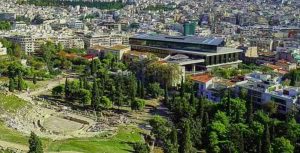
The Hills of Philopappou, the Pnyx, and the Nymphs
Along Koukaki’s western edge, the streets give way to roughly 180 acres of wooded parkland stretching across three connected hills: Philopappou, the Pnyx, and the Hill of the Nymphs.
Philopappou Hill, also known as the Hill of the Muses, takes its name from the Philopappos Monument at its summit. The marble mausoleum was built in the 2nd century AD for Julius Antiochus Philopappos, a prominent Roman consul.
People come here for the history, but they stay for the view. From the top, the Parthenon rises directly across from you, with the Saronic Gulf visible in the distance. If you can, go around sunset.
A short walk away is the Pnyx. It may look like a quiet, unassuming slope today, but this was where the citizens of ancient Athens gathered to debate and vote on public affairs. Beginning in the 5th century BC, it became one of the most important meeting places in the development of democracy.
Even the paths connecting these hills have a story. Architect Dimitris Pikionis designed them in the mid-20th century, blending reclaimed marble with natural stone. The result feels less like a formal walkway and more like something that has always belonged to the landscape.
Areopagus Hill
About 300 meters west of the Acropolis entrance stands the Areopagus, a rocky outcrop that once served as the meeting place of ancient Athens’ highest court.
According to mythology, the god Ares was tried here. Centuries later, the Apostle Paul is said to have addressed the Athenians from the same hill.
The climb is short, and the reward is one of the clearest views of the Acropolis anywhere in Athens. It is especially beautiful around sunrise, when the city is still relatively quiet.
The Temple of Olympian Zeus and Hadrian’s Arch
A short walk from the northern side of Koukaki brings you to the Temple of Olympian Zeus, also known as the Olympeion.
Once one of the largest temples in Greece, it now survives as a group of enormous columns. Only a fraction of the original structure remains, but the scale is still striking.
Next to it stands Hadrian’s Arch, built in the 2nd century AD in honor of the Roman emperor Hadrian and his contributions to the city.
The Ancient and Roman Agoras
Koukaki also puts the old centers of Athenian public life within comfortable walking distance.
The Ancient Agora is about 20 minutes away. In classical Athens, this was the center of politics, commerce, philosophy, and everyday civic life. Today, it is also home to the Temple of Hephaestus, one of the best-preserved ancient Greek temples in the world.
Closer to Plaka is the Roman Agora, which became the city’s main marketplace during the Roman period. Its best-known landmark is the Tower of the Winds, an elegant octagonal structure that once functioned as a sundial, weather vane, and water clock.
Traces of History Hidden in the Neighborhood
In Koukaki, history doesn’t exist only behind museum gates. It occasionally appears between apartment buildings, beneath trees, or at the edge of an ordinary street.
On Philopappou Hill, excavations revealed part of the ancient Koile Road, an important route connecting Athens with the port of Piraeus. Look closely and you can still see grooves worn into the stone by cart wheels centuries ago.
At the corner of Kavalloti and Misaraliotou streets, there is a small column fragment known locally as the “Klonaraki.” It is one of the surviving traces of a Roman bathhouse dating to the 2nd century AD.
Water also shaped this part of ancient Athens. The nearby Ilissos River was once considered sacred to the Muses, while traces of old waterworks—including fountains and cisterns connected with the Peisistratid water system—have been found in the surrounding area.
A Few Tips Before You Go
Visit early in the morning or toward the end of the afternoon. The light is softer, the marble takes on a warm glow, and the heat is usually more manageable.
Make time to walk along Dionysiou Areopagitou, the broad pedestrian street that connects many of the area’s major landmarks. With the Acropolis above and the wooded hills nearby, it is easily one of the loveliest walks in Athens.
Finally, wear shoes with a good grip. Centuries of foot traffic have polished the rocks around the Areopagus and Philopappou Hill until they are surprisingly slippery. This is one occasion when sturdy sneakers are a much better choice than sandals.