Plan your visit
Koukaki: How to Visit Athens’ Quiet Powerhouse Neighborhood
Koukaki sits between the Acropolis and Syngrou Avenue, and over the last decade it’s gone from a sleepy residential pocket to one of the most sought-after postcodes in Athens. People call it the “swan” of the historical center. The pull is the mix: ancient hillsides on one side, ordinary Athenian life on the other. To get it right, you need to understand how the district actually moves — the shaded, almost jungle-like feel of its pedestrian strips, and the small logistical headaches of any Greek city.
When to Go
Koukaki works in any season, though what you get changes a lot depending on when you show up.
The sweet spots are spring, March through June, and early autumn, September to mid-November. The weather’s warm enough to hike Philopappou Hill without suffering, and the streets smell of bitter orange trees.
Traveling cheap, or shooting content and want the streets to yourself? November to February brings noticeably lower room rates and discounts on tickets to big sites like the Acropolis.
High summer is the opposite. July and August get brutal — temperatures often climb past 40°C, and a lot of locals just leave for the coast. For the best atmosphere without the crush, aim for a weekday evening. The buzz is there; the weekend mob isn’t.
Getting There and Around
Few neighborhoods in Athens are easier to reach. Most people come straight from Athens International Airport on Metro Line 3 (Blue), switching at Syntagma to Line 2 (Red). Two stations serve the area: Acropoli, which drops you at the Acropolis Museum, and Syngrou-Fix, a busy hub that ties the metro to the tram and the buses.
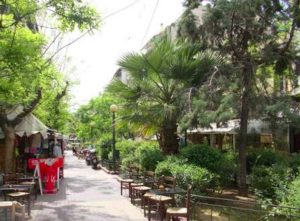
Once you’re in, walk. It’s the best way to see the place. Drakou and Georgaki Olympiou are car-free and function as the area’s communal living rooms.
A couple of warnings. Athenian sidewalks are often narrow, uneven, and treacherously slippery in the rain. And the crosswalk signals are notoriously short, so don’t dawdle when you’re crossing a main avenue.
Where to Stay
Koukaki’s lodging has tilted toward what the industry now calls “neighborhood lifestyle hotels” — boutique suites that lean on design and try to blend into the block rather than tower over it.
Want a view to brag about? COCO-MAT Athens BC, the Herodion, and the Acropolis View Hotel all have rooftops aimed straight at the Parthenon.
For something more lived-in, this is one of the best places anywhere for high-end short-term rentals. Book a renovated mid-century polykatoikia — a Greek apartment block — near the commercial spines of Veikou and Dimitrakopoulou, and you get to play temporary Athenian for a few days. Backpackers and solo travelers tend to land at Athens Backpackers or hybrid spots like Cohort Koukaki, which run social and lean digital-nomad-friendly, all a short walk from the metro.
Tips Locals Wish You Knew
Get on Athenian time. Most cafes won’t serve breakfast or brunch before 9:30 or 10:00 AM, and the neighborhood doesn’t really wake up until the cocktail bars and tavernas fill in the evening.
The good news on safety: Koukaki is one of the most secure parts of central Athens, fine for solo travelers and families well past dark. The usual caveats still apply in crowds — keep an eye on your pockets around the Syngrou-Fix metro station.
Two quirks worth filing away. First, the plumbing. Greek pipes are old and narrow, so toilet paper goes in the bin, not the bowl. Second, those gorgeous orange trees lining the streets are ornamental — the fruit is bitter and not worth the bite, so leave it where it is.
For produce you’d actually want to eat, go to the Friday Laiki Agora on Tsami Karatasou Street. It’s the real thing: a working street market, regional delicacies, and a clear window into how the neighborhood lives.